

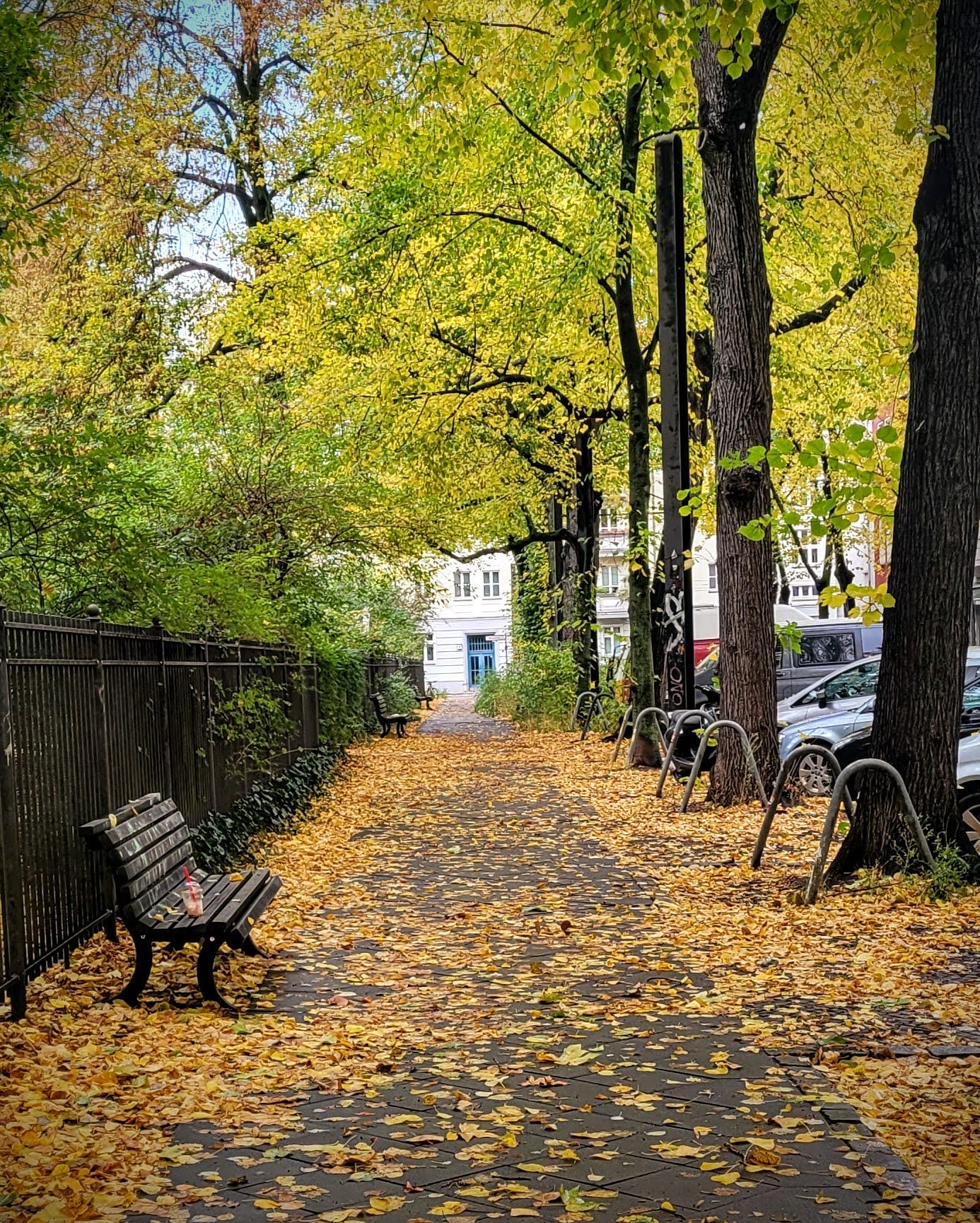
The weather here has finally turned significantly colder. We were fortunate to have a really glorious autumn, with warm days, nights with just a bit of chill, and trees full of colourful leaves in shades ranging from yellow, to orange to deep purples and reds.
Everyone seems to rave about the 24/7 party that is summer. But fall is my favourite time in Berlin.
The picture perfect autumn weather has been giving way gradually to darker, rainy and chilly days.
I’ve been taking a long online break to recharge, go on some long walks, and do a big fall clean up of the apartment. It’s the kind of deep cleaning, organising and giving away of unused things that I used to do in the spring.
But who wants to waste the precious warm weather and extra hours of sunlight on cleaning the apartment instead of getting outdoors?
Save cleaning and organising for rainy, dark days. We’re about to spend a lot more time indoors, so I wanted to do a big cleaning and reset of our indoor space.
I am also working on a reset of this newsletter.
This coming summer, we will have been in Berlin for five years. That will be long enough for us to apply for citizenship or permanent residency. And long enough that I already know several people who have moved here more recently. I can’t really claim to be ‘new in Berlin,’ anymore.
I’ve decided I want to refocus a bit.
I’m working on a sort of mini re-launch/rebrand of Alte Frau - New Life, which you guys will be able to read more about in the coming weeks.
Until then, posting will continue to be rather sporadic. But I hope it will be worth the wait.
For now, I hope you will check out these links to some other writers and creators who are doing some really great work.
📕📺🎧Read, watch, listen
This week’s ‘Read, Watch, Listen’ is unintentionally railway themed.
First up, Jon Worth, who writes about transit (mostly high-speed rail) in Europe wrote an insightful post about Deutsche Bahn and the current reputation for lengthy delays and cancellations.
JON WORTH: Your Deutsche Bahn joke isn’t funny (if it ever was)
Ultimately any German who has ever voted for any party other than the Grüne also deserves what they get. The Third Way / Die neue Mitte of Gerhard Schröder from the late 1990s is at the root of all of this, but twelve years of CSU transport ministers left their mark as well, and while Volker Wissing (FDP) redeemed himself as at least being better than his party, the current government looks to be back to where it all was pre-Wissing. So if you're laughing at Deutsche Bahn, and voted for one of those parties that helped cook up the current situation, well, this is at least in part on you.
Read the rest at the link above.
Then I found this cool video posted by Reddit user u/vladgrinch of a visual representation comparing all of the trains running in Germany and France on a single day this past month.
Watching the images of different journeys, you can see what many railway advocates have been pointing out for some time: German has more reported delays and cancellations—but it also runs more trains to more places more frequently that many of its neighbouring countries.
That is not to say that Deutsche Bahn shouldn’t do more to improve its reliability. But it is something to keep in mind.
REDDIT: France vs Germany — Every train of the same day, Thursday 15 October 2026.
Finally, a YouTuber I have followed for a while, Brian Alex, posted this video about Berlin’s former railway terminals. Even if you aren’t particularly into architectural history, his video does a great job explaining how Berlin’s commuter rail transit system developed. At the end of the 19th century, Berlin (still a loosely connected metropolis of independent cities and villages) had eight separate mainline railways running through it. Each railway had a separate terminal station. Only one of these, Ostbahnhof, remains in operation.
🗺️Beyond Berlin …
Finally - and this certainly deserves better promotion than the bottom of this post - I have been binge-reading Hospitalstrasse22. There, Victoria is tracing the history of her family in the town of Memel, East Prussia - what is now Klaipėda, Lithuania.
It is a complicated story set in a country that no longer exists. In her words, “a forgotten landscape.”
Her great-grandmother and grandmother were just two of the millions of Germans expelled from the territory lost by Germany at the end of World War II.
They were not part of Hitler’s “Heim ins Reich” movement, which resettled thousands of Germans on land confiscated from Polish and Jewish people in conquered terrority. (In fact, her family’s house was confiscated by local Nazi sympathizers.) These families had lived for generations in a part of eastern Europe that had been majority German-speaking since the Middle Ages.
With their sons and husbands conscripted into the Wehrmacht, they were caught between the Nazis and the advancing Red Army in the closing days of the war.
Piecing together details combed from old records and family correspondence, her stories highlight a family ensnared, like so many others, in a fight they had no part in starting.
I follow Johanne and Irene’s flight west in the closing stages of the war, never to return home. I muse on the idea of Odo, Johanne’s son, being 90 years old, and write about him as a lost young lad getting into trouble and eventually being rounded up by the Soviets. I chart how Emil, Johanne’s father-in-law, walked onwards, frail and freezing, into the snowstorm near Königsberg in December 1944, never to be seen again. …
Read the rest at the link.

🥙Buy Me a Kebab!
If you want to support this newsletter without a regular subscription, consider leaving a small, one-time contribution at the link below.
(This is Berlin, so it’s döner kebabs instead of coffee!)
The leaves here don't look as good here, don't know why.