
An Uphill Climb
The push to reduce car traffic in central Berlin reaches a critical moment.

I am convinced that the biggest myth that needs busting about life in Berlin is not that it’s still ‘poor but sexy,’ or that non-millionaires can still get a new rental contract in Prenzlauer Berg.
It’s that taking a taxi when the bus is late will get you there on time.
I was reminded of this Thursday as I strolled past a long line of cars stuck in traffic on a small street near my apartment. Although I saw the occasional taxi or work van, behind the wheel of most vehicles sat a single, very frustrated driver.
I was almost sitting among them. Road and tram-line construction have created traffic bottlenecks all over Lichtenberg and Friedrichshain, leaving tram riders depending on replacement buses to complete their journeys, and drivers taking detours off main roads through neighborhoods.
I was coming back from a parent meeting at my son’s school (Lichtenberg) and waiting at a bus stop for the ride back to where I live (Friedrichshain). As multiple estimated departure times came and went - and the crowd of waiting riders grew to well more than a single bus could handle - I began eyeing the Freenow app on my phone.
Drivers were in the area - the closest one could pick me up in four minutes! So the app claimed. It would have been almost a straight shot down Weißenseer Weg to Möllendorfstrasse and on to my neighborhood. Admittedly, I was already only a little more than a mile and a half away.
But as I shifted my gaze to the street in front of me - the four lanes of traffic that had not budged in the 15 minutes I had been standing there - I remembered this was an illusion.
There was no way a cab could magically appear where hundreds of other cars were currently unable to transit. It would be stuck in traffic - probably right behind the replacement bus I was already waiting for.
I decided to hoof it.
Many European cities either have or are seriously considering implementing “car free” zones in their city centers. This video from the YouTube channel City Beautiful explains why and which ones have already been successful.
What is Berlin Autofrei?
Situations like these are what the organizers of Verkehrsentscheid Berlin Autofrei (‘Traffic Referendum for a Car-Free Berlin’) are hoping to address with their proposal - a law restricting private car trips inside Berlin’s central core.
Since January, they have been collecting signatures for a petition that would allow a referendum in September. It’s an uphill battle.
They have to get 174,000 valid signatures by May 8—that’s next Friday—in order to put the measure up for a public vote. As of April 2, organizers had submitted only 46,200 signatures to the State Election Office, though there are an unknown number of signatures that have been sent in to district offices.
You can read a draft of the proposed legislation here.
If the referendum is held, a majority of voters must approve of the new law and at least a quarter of all eligible voters must participate and vote to approve it, in order for the initiative to pass.
If it passes, the new law would:
Allow only 12 private car trips per person1 inside the Ring each year, with exceptions allowed for people who are disabled and need to use a car; for commercial and delivery vehicles; and for public transit and public safety vehicles.
Eliminate almost all long-term car parking on surface streets there.
In 2003, the city of Seoul, Korea decided to rip out a major highway running through the middle of the city in favor of restoring a natural stream that had been there. Opened in 2005, the linear park along the stream is one of the city’s most popular areas.
What opponents are saying
The opinions I have seen in opposition range from very reasonable to fundamentally misunderstanding (or misrepresenting) the concept. So here is my attempt to objectively look at the arguments.
(Disclosure: Longtime readers know that our family doesn’t have a car and we live inside the Ring. Our two kids are teenagers and old enough to bike and use public transport by themselves. This, obviously, colors my perspective.)
We don’t need this, the entire area inside the Ring is already a low-emission zone. Reducing car traffic is about more than improving air quality. The goal is to have more of a balance in the use of public space between the huge amount currently dedicated almost exclusively to cars and what is available for other uses, like better sidewalks, efficient public transit, and safe bike lanes for the 51 percent of Berlin households who don’t own cars. Think about the huge amount of land currently dedicated to on-street parking, parking lots, and parking decks. Then add in multi-lane streets of bumper-to-bumper traffic, as I mentioned above. The slogan for Berlin Autofrei is literally “more space for Berlin.”
Public transit is not ready to support the additional demand. This is a very reasonable concern. While the Berlin inner city has some of the best public transit in the world—a subway system, commuter rail system, extensive bus network and a tram network—it is often not very accessible to people with disabilities or those with babies and young children.
(Yes, I too have seen people in wheelchairs using the bus system and been crammed in next to multiple moms pushing those giant prams on a tram. But I also don’t know how they cope with inaccessible transit stops in the rain, as well as the many times the elevators at the train stations aren’t working.)
The proposed legislation calls for a four-year transition period during which the transport companies would use to prepare for the increased ridership. We know how that can go. However, nothing motivates like a hard deadline - so the law could be the needed kick in the pants to get the access issues addressed.
On the other hand, the ‘my bus is always late’ argument is an example of not understanding the root of the problem. Buses and trams are late because they get stuck behind cars or get into accidents with cars and that makes them late. Reduce the number of cars - and consequently the number of idiots who do things like this - and transit times would improve.
I have a disability or need a car to do my job. The law contains explicit exemptions for people who depend on automobile use due to disability and for commercial vehicles.
It will hurt the local economy and make traffic outside the Ring worse. Multiple other cities - from Paris, to Oslo to Barcelona - have already implemented large-scale measures to reduce car traffic in their city centers and have found the opposite to be true.
Enough people transitioned to transit alternatives that it did not result in floods of traffic through the outer areas. Plus, people who would have been discouraged by the hassle of traffic and parking were drawn to the pedestrianized areas for shopping, dining and recreation.
Berlin also has a number of smaller, localized projects that show overall positive results. In Kreuzberg’s Graeferkiez, for example, where the district has removed over 700 parking spaces since 2023, a majority of residents and business owners there say they are happy with the changes.
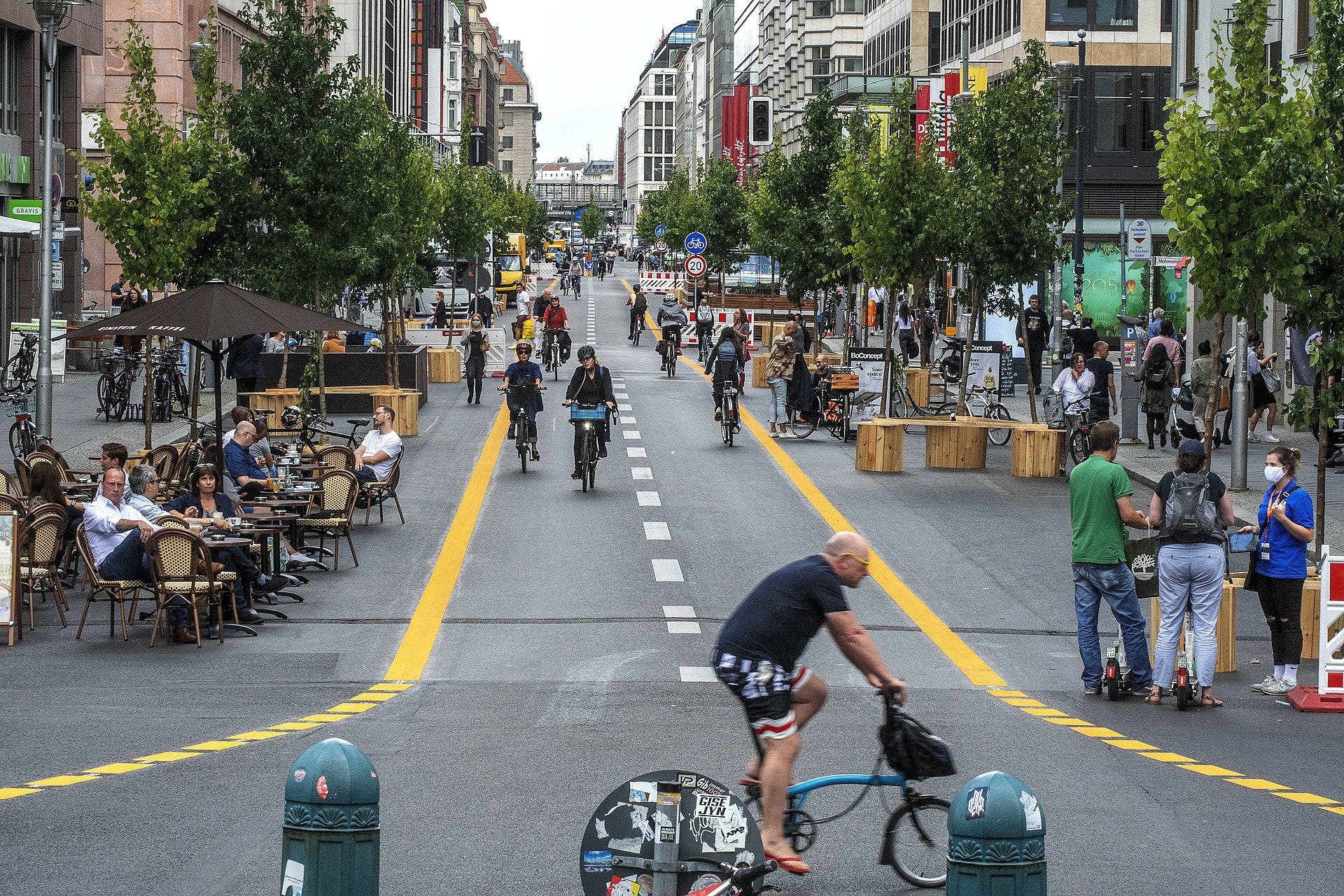
Even the very car-friendly current Berlin government announced plans to make the central shopping street, Friedrichstrasse, friendly to pedestrians again. A 500-meter section of the street was closed to cars from 2020 to 2022, but reopened to cars after a court ruled the previous government acted improperly.
Public space should be for everyone (my response to the ‘freedom’ argument)
There are definitely reasonable arguments to be made on both sides of the current proposed law.
But nothing gets me going more than the arguments put forward by the local CDU and BSW parties - who are both using their opposition to the law to rally support from their bases in suburban Berlin, where car ownership is highest.
The law would force a “radical lifestyle experiment” on citizens who should be able to “choose” their preferred mode of transportation, whether that be car, bike or transit, according to an argument put forward by Berlin Mayor Kai Wegner.
The problem is, the only choice they support (and heavily subsidize) is the choice to drive a car. The status quo protects and prioritizes the car drivers’ choice at the expense of everyone else’s.
I would choose to ride a bike. But the Berlin government has attempted to remove bike lanes wherever it can and halt construction of new ones because they feel they impede car traffic.
They also don’t enforce parking regulations. Nine out of every 10 bike trips, I deal with cars parked on the bike lane or illegally parked along city streets, limiting sight lines for pedestrians and bike riders, alike.2
But nothing epitomizes the absurdity of the city’s car policy more than the number of city residents keeping junk cars parked on the street and using them for storage, rather than renting a storage unit, because the resident parking fees are cheaper.
We need to more equitably balance the wishes of car drivers with those of the community at large.
I don’t hate cars and I think there are times when cars are necessary and useful. But I think the idea that everyone should be able to freely drive their individual car wherever they want to and park it directly next to each destination is ridiculously wasteful, inefficient, and harmful to the environment.
It’s probably too soon
As I said above, it seems unlikely that Berlin Autofrei will get enough signatures to hold its referendum this year. But I believe its day is coming.
When I was walking my unexpected 1.5 mile trek earlier this week, at no point did I wish I had a car. That would have just put me in the traffic jam with everyone else. I did wish I had brought my bike helmet along, as I passed several rental e-bikes and e-scooters, and other people zipped by me in the bike lanes.
I was lucky, though, that the weather was sublime and I actually found myself enjoying the walk.
Cities all over the world that are de-prioritizing private cars are thriving. And if Berlin wants to continue to thrive, it will eventually have to get on board.
In the meantime, if you are a German citizen and live in Berlin, you will probably see volunteers out collecting signatures this holiday weekend. Consider giving them your support.
More About Berlin AutoFrei
RBB24 - RadioEins. Berlin autofrei: Was steckt hinter dem Verkehrsentscheid?
Volksentscheid Berlin Autofrei: Konzept für eine autofrei Berliner Innenstadt.
Yes Magazine: Can a Major City Go Car-Free? Berlin Might Know Soon Enough.
ADFC Berlin: Verkehrsentscheid: ADFC Berlin teilt das Ziel einer lebenswerten Stadt
More About ‘Car-Free’ Cities in Europe
EU Urban Mobility Observatory: Nine European cities paving the way for car-free living.
Fast Company: What happened when Oslo decided to make its downtown basically car-free?
Bloomberg. Barcelona will supersize its car-free ‘superblocks.’
For example, in a family of four, each family member can make 12 trips a year, a total of 48 trips for that household.
And, I live in a district with the lowest rates of car registration in the city.


