

How Berlin Jumped the Line
The Greater Berlin Act of 1920 made the Prussian capital the world's third largest city overnight.

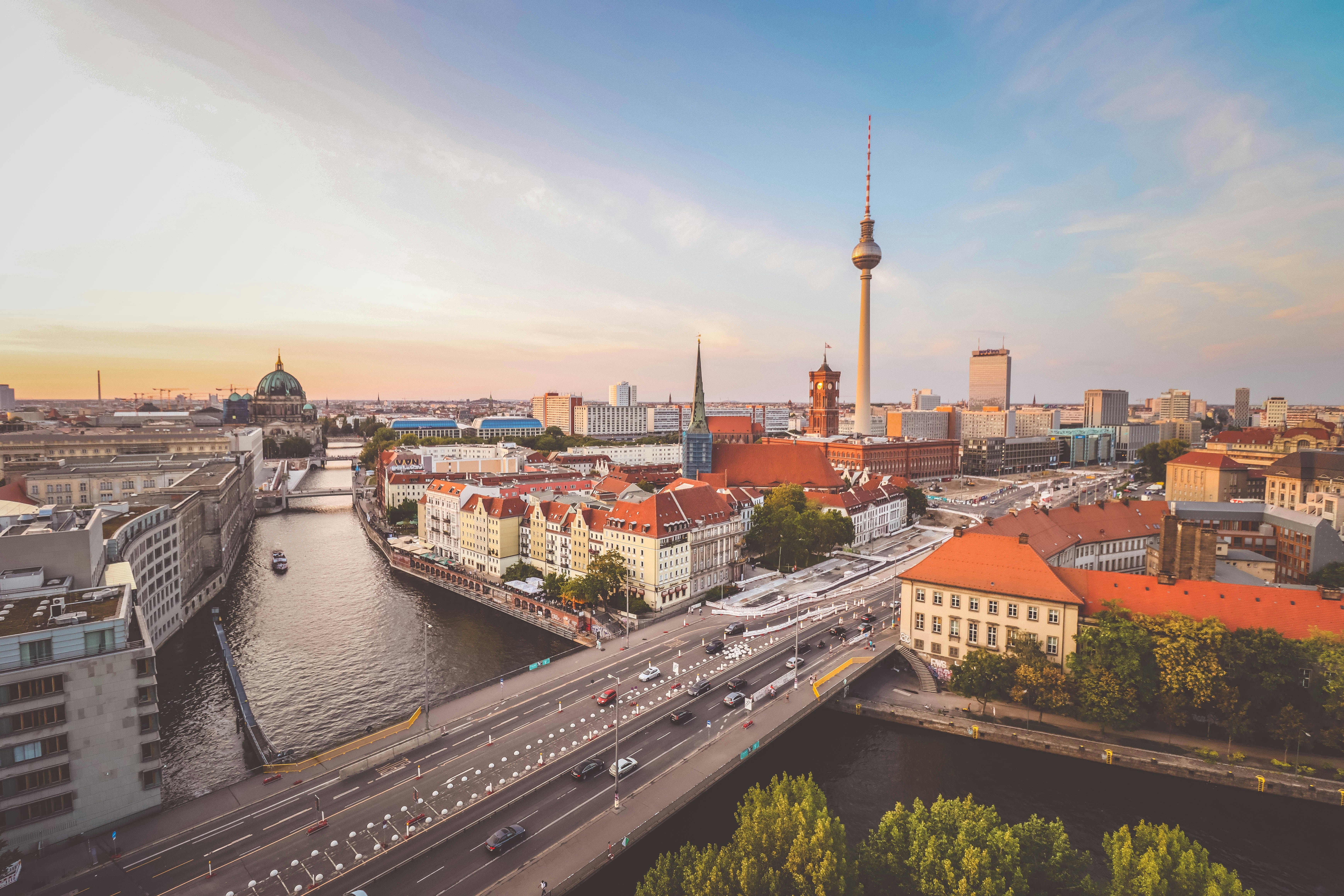
Visitors and residents new to Berlin - especially those who have been to other German cities - often have a common question upon first experiencing it: Why doesn’t Berlin have the typical ‘Altstadt’ at its center?
If you’ve been to other German cities and towns, they are all, to some degree, centered around an “old town” plaza that is centered on two anchors: a large, old church and a large, old town hall.
And Berlin does have this physical center area in Alexanderplatz - where the Rotes Rathaus is, as well as the Nikolaiviertel, the oldest part of the original city of Berlin. On its borders reside the Berliner Dom, the elaborate neo-Renaissance cathedral church of the imperial kaisers, and also the controversially reconstructed royal Berliner Schloss (Berlin Palace).
But it doesn’t really feel much like the center of Berlin, just one of many popular places in a very large metropolis.
Some have speculated that the total destruction of most of the city during the Second World War, plus 40 years’ of division during the Cold War are the reason for the lack of cohesion. And while those catastrophes certainly contributed, the truth is that Berlin doesn’t lack a city center — it has many city centers.
I once heard someone say that Berlin is not really a single large city, but “five medium-size cities in a trenchcoat.”
And I don’t think there could be a more accurate description. In truth, the real roots of Berlin’s urban sprawl lie in an event that happened earlier, on the 27th of April, 1920.
The Greater Berlin Act of 1920
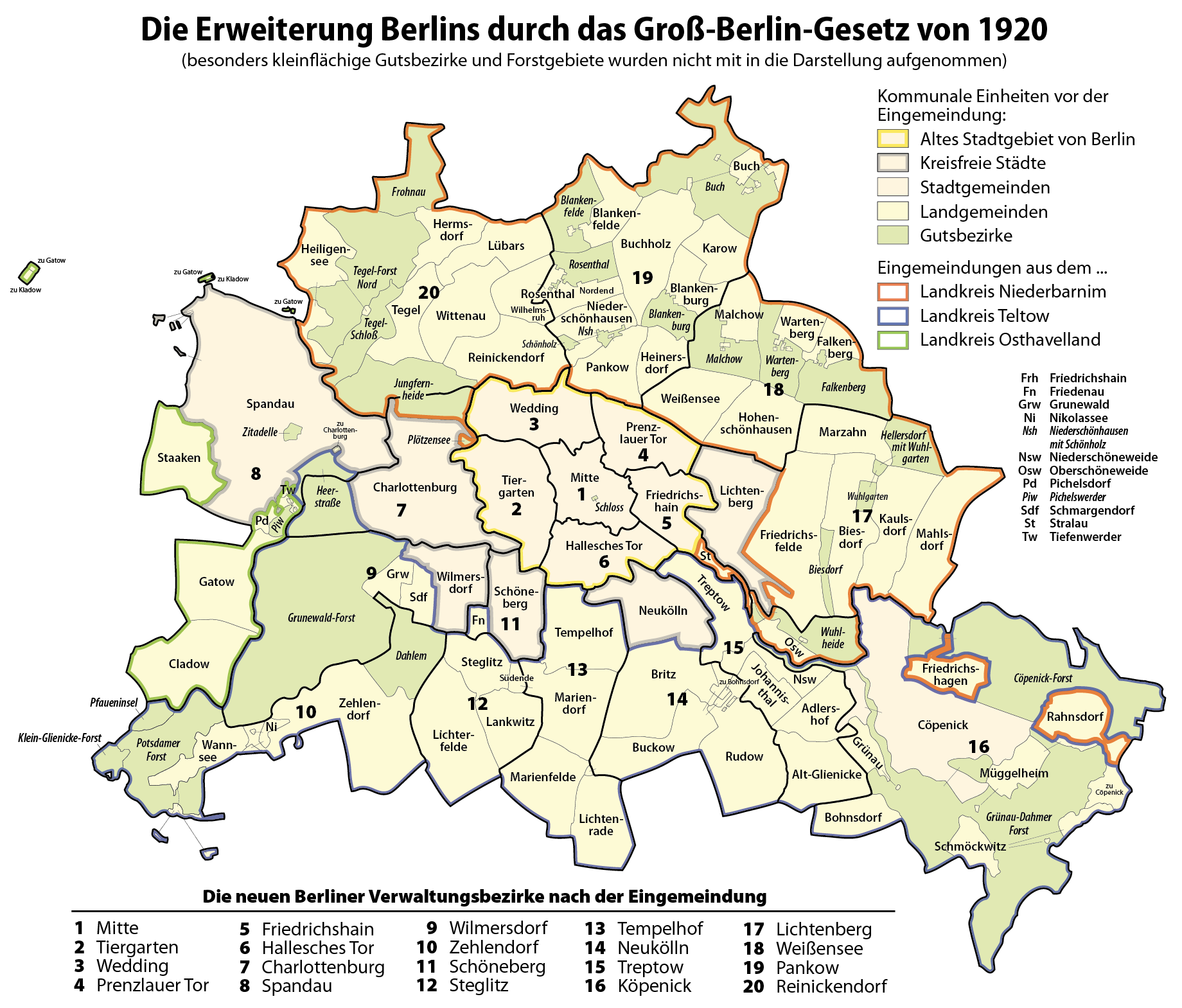
On that day, the Prussian state parliament passed the Greater Berlin Act, official title: the Law Regarding the Creation of the New Municipality of Berlin.
The law, when it took effect the following October, instantly doubled the city’s population from 1.9 million people to 3.8 million by incorporating seven surrounding towns; 59 rural communities; and 27 estate districts1 all in one fell swoop. The land area increased from the 65.72 square kilometers of Alt-Berlin to 878.1 square kilometers of the newly created Greater Berlin.
The new city became the third largest city in the world at the time, with a population just behind London and New York.2
Though the change was sudden, the effort to enact some form of governance over the whole Berlin connurbation had been going on in some form for decades. The cities and towns surrounding Berlin had been growing toward the center in the last decades of the 19th century as the area had rapidly industrialized.
In the crowded industrial districts, workers lived in overcrowded tenements in unsanitary conditions. The growing metro urgently needed more oversight for housing, transportation services and wastewater management.
Berlin is not really one large city, but ‘five medium-size cities in a trenchcoat’
According to historian Herbert Schwenk, by 1900, the 151 towns and municipalities in the Berlin area had 43 different gas, 17 water, and 15 electricity companies working side by side.
Conflicts were unavoidable and increasingly frequent.
While (Old) Berlin used Lake Tegel as its main source of drinking water, for example, the towns of Reinickendorf and Tegel channeled their wastewater there.
A more centralized authority was increasingly necessary.
Even so, the idea of becoming one big city was not universally popular.
According to the information about the plan published on the Berlin government website, the final vote was close:
“For a long time, it looked as if middle-class conservative groups in the wealthy suburbs - such as Charlottenburg, Zehlendorf and Spandau - would be able to prevent the formation of Greater Berlin. The vote in the Prussian Constituent Assembly was close: the law was passed by 164 votes to 148 with five abstentions.
The Social Democrats (SPD), the Independent Social Democrats (USPD) and parts of the left-liberal German Democratic Party (DDP) were in favour, while the more bourgeois parties Deutschnationale Volkspartei (DNVP), Deutsche Volkspartei (DVP) and the Catholic Centre Party opposed it.”


Out with the old
And so, overnight, posh villa districts like Grunewald and Lichterfelde, independent municipalities like Charlottenburg, Spandau, and Köpenick, the gritty industrial areas of Wedding, Kreuzberg, and Friendrichshain, and agricultural manor estates like Britz and Buch, all became one city—Berlin.
The Prussian Constituent Assembly, created in the aftermath of the 1918 abdication of Kaiser Wilhelm II, and which had been tasked with transitioning the government from the Kingdom of Prussian into a self-governing Free State of Prussia, had the power to unilaterally order the annexation of all the separate entities into one.
The Prussian government legally had to compensate the surrounding Brandenburg regions, which lost a huge chunk of their tax base, but none could oppose losing the territory. Similarly, the private landowners who had had total administrative and financial control of the large manor estates located within the new city’s boundaries retained ownership of the land, but lost all administrative control — including the authority to issue and collect taxes and the responsibility of providing police and fire protection and other public services.
The new city was divided into 20 boroughs (known as Verwaltungsbezirke):
six from the original city of Berlin (Mitte, Tiergarten, Wedding, Prenzlauer Berg, Kreuzberg, and Friedrichshain);
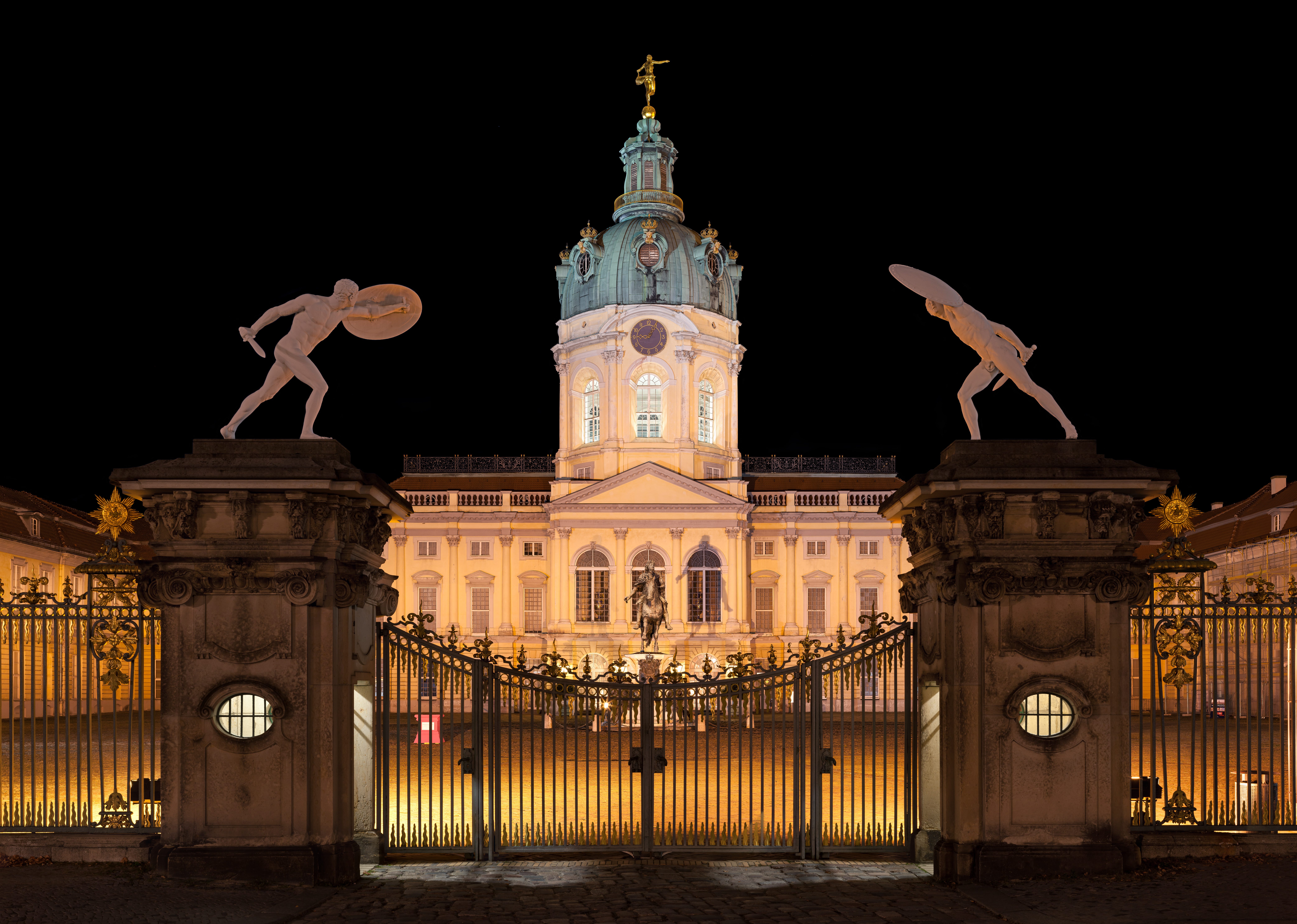
one each for the seven previously independent towns and cities (Charlottenburg, Köpenick, Lichtenberg, Neukölln, Schöneberg, Spandau, and Wilmersdorf);
and seven new boroughs created for the remaining added areas, with each borough named after the largest village in the area at the time (Pankow, Reinickendorf, Steglitz, Tempelhof, Treptow, Weißensee and Zehlendorf).
.jpg)
Although the city limits have largely remained the same since 1920 - even surviving the division of the country - the interior administrative organization has changed.
During the division of Berlin and Germany following World War II, the boroughs were reorganized by their respective governments and some new districts were added.
Following reunification, the boroughs were reorganized again. Administrative reforms passed in 2001 reduced the number of borough from 23 to 12, merging and combining some to reduce the total number.
Today, the 12 Berlin bezirke are:
Mitte, (which includes the original boroughs of Mitte, Tiergarten, and Wedding);
Friedrichshain-Kreuzberg;
Pankow (which now includes the former separate boroughs of Prenzlauer Berg and Weißensee)
Charlottenburg - Wilmersdorf;
Spandau;
Steglitz-Zehlendorf;
Tempelhof-Schöneberg;
Neukölln;
Treptow-Köpenick;
Marzan-Hellersdorf;
Lichtenberg (which also includes Hohenschönhausen); and
Reinickendorf.
We are all Berliners
In addition to the boroughs, there are hundreds of different small localities all over the city that harken back to a village or farming estate that was incorporated into it. Some of these places are older the original Berlin. And some have been assigned then re-assigned to different city boroughs over time, separating them from their historical context and obscuring much of their history.
For example, we live in what is now part of Friedrichshain, which was already part of Berlin before 1920. But, the area we live in is the former village of Boxhagen, which - together with the neighboring village of Rummelsburg - had been annexed into the city of Lichtenberg before it became part of Greater Berlin.
Today, the Boxhagener area is part of the borough of Friedrichshain, but Rummelsburg remains part of Lichtenberg.
To me, the area still “feels” like it goes with Lichtenberg, much more than it does the rest of Friedrichshain. And, Friedrichshain feels completely different from Kreuzberg, which is across the Spree River.
Fun fact: During the time of the DDR, Kreuzberg was in West Berlin and Friedrichshain was East Berlin—the river was the border.
So, if you have ever been in Berlin and noticed that one area has completely different architecture and even a different-looking street grid from a neighboring one, this is why.
It may have nothing to do with east versus west. But historic divisions from much farther back.
Sources
Urban planning for governing the metropolis – The case of Greater Berlin 1900-1920. by Christopher Bernhardt. Inventer le Grand Paris: Histoire croisée des métropoles, 2016.
The Greater Berlin Act. Berlin.de - The Official Website of Berlin. January 17, 2024.
Power and Powerlessness - A Series of Major Plans. Unvollendete Metropole. Unfinished Metropolis. An exhibition on the 100th anniversary of Greater Berlin.
1920 - A Crisis Year. Unvollendete Metropole.
The historic villages hidden in Berlin. The Berliner. March 2, 2023.
Estate districts (Gutsbezirke in German) were owned and controlled by a private landowner (Gutsherr), often a member of the Prussian nobility. A holdover from feudal times, these districts were run by a single person who collected and kept all taxes from goods produced on the land and provided all public services. Residents of the estates were tied to the estates and were not considered residents of the adjoining towns or communities.
It was the second largest by area. At the time, only Los Angeles was larger.
New GI’s took the Baroque architecture in Lichterfelde for granted. It surprises my fellow veterans when I tell them that it developed with the railway and tram lines. Real estate developers in 1920’s Berlin went faux baroque.
Thank you for filling in lots of gaps. The first page of my website history of the landhaus at Sven-Hedin-Strasse 11 fits with your article.