
November 9 - Remembering the Real History of 'Kristallnacht'
Far beyond a night of broken glass, the November pogroms were a turning point in Nazi persecution of Jewish people

The 9th of November is known across Germany as a “Schicksalstag,” a “fateful day” in the nation’s history. The first German republic was proclaimed on this day in 1918. But it is also the day of the Hitler Putsch (also known as the Beer Hall Putsch) in 1923.
It is the date the Berlin Wall came down, but the event that led to the reunification of Germany is commemorated on a different day - October 3, the day the country was officially reunited.
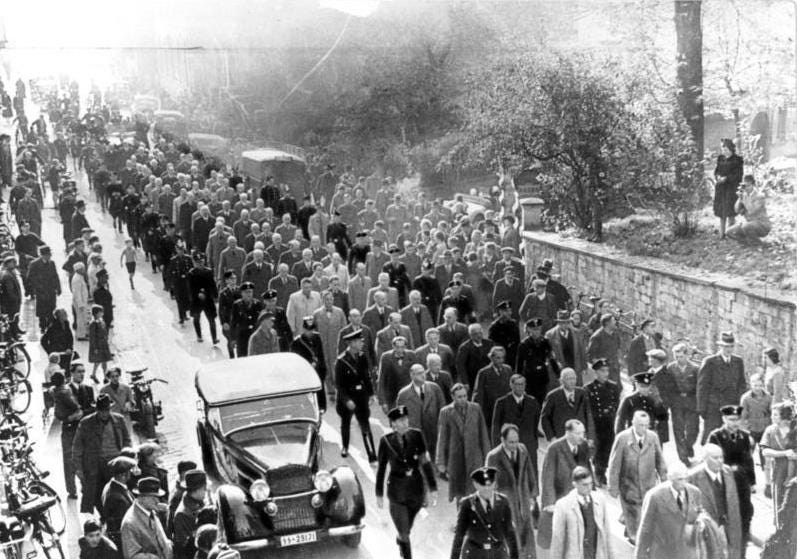
It is also the day of the November pogroms - a wave of coordinated attacks against the Jewish population that occurred all over Nazi Germany between November 9 and 10, 1938.
When I was growing up in the United States, we learned about these events by another term, “Kristallnacht.”
Translated as “The Night of Broken Glass,” we were taught it was a wave of vandalism that targeted Jewish businesses, escalating the legal and social discrimination against Jews. In reality, the pogroms of November 1938 involved much more severe violence than broken shop windows.
All across the German reich, which by that time included Austria and the Sudeten region of Czechoslovakia, Jewish people were attacked at their homes, businesses, houses of worship, and in public. Modern historians estimate between 1,000 and 2,000 Jewish people were murdered in these attacks.1
Thousands of synagogues were burned and Jewish businesses destroyed. Almost 30,000 Jewish men were rounded up and sent to concentration camps at Buchenwald, Dachau, and Sachsenhausen. This marked one of the first times that Jewish people were sent to concentration camps simply because they were Jewish and not under the pretext they had committed some other crime.
The pretext
The attacks across the country were organized and coordinated by local divisions of the Nazi Schutzstaffel (SS) and Sturmabteilung (SA) who were instructed to dress in plain clothes to make it appear that the actions were spontaneous riots by the local population instead of coordinated attacks by national leaders.
The “riots” were ostensibly in retaliation for the assassination in Paris of a German diplomat, Ernst vom Rath, by Herschel Grynszpan, a Polish Jewish teenager.
Almost two weeks previously, at the end of October, more than 17,000 Polish Jews living in Germany had been arrested without warning, transported by guarded train to the border, and forcibly expelled from Germany. This was known as the Polenaktion (Polish Action).
In some places, surprised Polish authorities refused to accept the deportations and used force to prevent the deportees from crossing into Poland. They were then caught between the German army on one side and the Polish authorities on the other. Those caught up in the no man’s land between the two countries - an estimated 8,000 people - were taken to an internment camp in the border town of Zbąszyń.
Among them was the family of Sendel Grynszpan, Herschel’s father. Herschel learned by a postcard from his sister that his entire family had been deported from Hanover without time to pack their belongings or take any money.
She begged him to send anything he could. But, as his Polish passport had also recently been invalidated, he was deemed to be illegally residing in France and couldn’t work. He was penniless and had been in hiding in an uncle’s attic.
Grynszpan obtained a revolver and shot Rath at the German embassy in Paris on November 7, 1938. Rath died of his injuries on November 9.
Premeditated “acts of spontaneous rage”
Before the French police had even finished their investigation into Rath’s shooting, members of the Nazi leadership were disseminating the conspiracy theory that Grynzspan had acted on behalf of “world Jewry,” which was allegedly plotting to damage French-German relations and incite a war between the two countries.
Even on November 7, the German News Bureau (DNB), a central institution for press control in the Nazi state, issued a directive that the report of the assassination should be “highlighted in the greatest possible way” in all newspapers and that it should be particularly “emphasized that the assassination must have the most serious consequences for the Jews in Germany.” [text translated from German]
As Rath was not a well-known figure, news of the shooting did not reach the wider German public until the afternoon of November 9, when it was reported that he died.
But attacks on Jewish people and businesses were already taking place throughout the country on November 7, notably in Hesse-Kassel and Magdeburg.
By the evening of November 9, Nazi propaganda minister Joseph Goebbels was sending telegrams to across the country to local groups of SS and SA, instructing them to destroy Jewish businesses and synagogues directly.
“All Jewish businesses are to be destroyed immediately by SA men in uniform. After the destruction, an SA guard is to be posted to ensure that no valuables can be stolen. […] The press is to be called in. Jewish synagogues are to be set on fire immediately, and Jewish symbols are to be secured. The fire brigade is not to intervene. Only the homes of Aryan Germans are to be protected; however, the Jews must be evicted, as Aryans will be moving in there in the next few days. […] The Führer wishes that the police not intervene. All Jews are to be disarmed. Anyone who resists is to be shot dead immediately. Signs are to be placed on the destroyed Jewish businesses, synagogues, etc., with a text such as: ‘Revenge for the murder of vom Rath. Death to international Jewry. No understanding with peoples who are subservient to Jews.’ This can also be extended to Freemasonry .”
—Günter Brakelmann: The Protestant Church and the Persecution of Jews. Three Insights. pp. 47 f.
Reaction of non-Jewish Germans
Though the attacks were orchestrated and largely committed by dedicated members of the SS and SA, they were heavily supported and exacerbated by local police forces and residents of local communities, either out of racial animus or because they wanted to confiscate the homes and property of Jewish families.
Almost everywhere, the local fire brigades and police departments, following orders, only protected neighboring buildings from the spread of the fires that had been set, thus enabling the unhindered destruction and looting (the latter was denied by Nazi propaganda) of Jewish property.
Very few cases of civil courage are documented: Wilhelm Krützfeld , head of the responsible police station in Berlin-Mitte, saved the New Synagogue on Oranienburger Straße by invoking the building’s protected status as a historical monument, chasing away the SA arsonists with some officers, and calling the fire brigade, which extinguished the blaze.
…
In the course of the riots and the chaos in which they took place, numerous Jews were murdered. In Lesum , a suburb of Bremen, for example, the mayor and head of the local SA stormtroopers, due to a communication error, believed that all Jews were to be killed. Passing on this erroneous order led to the murder of a doctor from Lesum and his wife. In Austria, SA men did not allow a newlywed couple to take their infant child, only a few months old, with them when they were arrested. The baby was left unattended in the apartment and died.
Notably, some Germans—even ones who had previously expressed anti-Semitic beliefs—were unnerved by the violence and destruction against innocent people. Very few people made any effort to intervene, however.
Reports from many regions of the Reich indicated that the pogroms had been met with shame and horror. Donations to the Winter Relief Fund were refused in protest against the pogroms. According to communication scholar Nadine Deusing, the evidence clearly predominates for a critical attitude among unaffected Germans, whether due to the destruction of property, violations of law and order, or the evident lowering of inhibitions against violence, from which many feared becoming victims themselves at the next opportunity. However, open protests almost never occurred at the scenes of the pogroms because people were afraid.
Former Kaiser Wilhelm II, in exile in the Netherlands, denounced the pogroms as “gangsterism,” but reports that he said they made him “ashamed to be German” were later deemed to be false.
Communist leaders were among the few outspoken opponents of the Nazi regime and its persecution of Jewish people.
The pogroms strengthened the opposition of those who were already opponents of the Nazi Party. For the Kreisau Circle under Count Helmuth James von Moltke, they were, in retrospect, a decisive impetus for the assassination plans against Hitler during the Second World War . Following the pogroms, resistance groups of the Communist Party of Germany (KPD) distributed an issue of the newspaper “Die Rote Fahne” (The Red Flag) in Berlin , which, under the title “ Against the Disgrace of the Jewish Pogroms ,” called for solidarity with all Jewish citizens. The anti-Semitic riots were not an expression of “popular anger,” but rather a “distraction of the people from the war policies pursued by capital.” The exile journal “Sozialistische Warte “ (Socialist Watch) of the International Socialist Committee (ISC) described the pogroms in its November 18th issue, in an article entitled “Repressions!”, as “the lowest point of legal certainty in any state” and as a “crime that cries out to heaven.”
The response of Christian leaders, for the most part, ranged from silence to mild critiques of the nature (but not the purpose) of the attacks, to enthusiastic cheerleading, with several invoking the name of Martin Luther to justify the pogroms.2
One notable exception was the Württemberg village pastor Julius von Jan from Oberlenningen. On November 16, Jan preached from the pulpit on the Day of Repentance and Prayer, using the prescribed biblical text Jeremiah 22:29 (“O land, O land, hear the word of the Lord!”):
“Passions have been unleashed, commandments disregarded, houses of worship sacred to others have been burned down with impunity, the property of foreigners stolen or destroyed. Men who faithfully served our German people […] were thrown into concentration camps simply because they belonged to a different race! Even if the injustice is not admitted by those in power, the healthy instincts of the people clearly feel it, even where they do not dare to speak of it. And we as Christians see how this injustice burdens our people before God and must bring His punishment upon Germany. […] God will not be mocked. What a person sows, that will he also reap!”
-Günter Brakelmann: Evangelische Kirche und Judenverfolgung. Drei Einblicke. S. 56 f.
The minister was later severely beaten in front of his rectory by members of the local SS and SA, then arrested and put on trial for charges of “incitement against the state.”
Shift in the persecution of the Jews
In retrospect, the November pogroms of 1938 have been seen as the point when Nazi policies openly shifted from social and legal persecution to one of terror, foreshadowing the Holocaust to come.
For Jews living in Germany, it finally became unmistakably clear (if it was not already) that they could no longer even take their lives for granted. After 9 November 1938, the number of them who made efforts to emigrate skyrocketed. In the few months before the war broke out, around 200,000 Jews left the Reich. Although there is no straight line leading to the mass murder of the Holocaust, the acts of terror of 9–10 November 1938 mark a drastic turning point.3
Why the term Kristallnacht is outdated
The term Kristallnacht was a phrase used by Germans in the time just after the pogroms occurred, to connote a defeat of the Jewish population. After the defeat of the Nazis, it was seen to be trivializing and distorting the events to de-emphasize the violence, as if it were primarily just about broken glass.
It also gave the impression that the attacks took place over the course of one night, when, in fact, they occurred during the day and evening over the course of several days.
In Germany today, the terms Reichspogromnacht or ‘November pogroms’ are used. Pogrom is a term borrowed from the Russian word for violent attacks designed to drive out or eliminate a particular religious or ethnic group. It has usually been associated with riots or massacres of groups of Jews in Russia and eastern Europe.
Despite November 9th’s association with other important events in the nation’s history, German leaders have not wanted to commemorate positive events on a day internationally associated with these crimes.

Read More About the November Pogroms
Wikipedia. Kristallnacht. Accessed November 7, 2025.
Jewish Museum of Berlin. 9th of November, 1938/ “Kristallnacht.”
Holocaust Encyclopedia. Kristallnacht.

Richard J. Evans: The Third Reich. Volume 2: Dictatorship. Deutsche Verlags-Anstalt, Munich 2006, p. 714.
Bastian Scholz: The Churches and the German Nation-State. Confessional Contributions to the System’s Preservation and System Change. Springer VS, Wiesbaden 2015, ISBN 978-3-658-11508-1 , pp. 352–354.
Jewish Museum of Berlin. 9th of November, 1938/ “Kristallnacht.”


Thank you for this article (and your many others during your stay in Germany). It provides an excellent resource to fill in the understated or missing pieces to that awful period.
Sadly, if you live in Sudan, Yemen, or Syria, and elsewhere, there is much that is unreported - we know but we fail to act. Martin Niemoller was so correct in his statement.
Got to be proud of the Germans who fought back against the Pogrom. That had to take a lot of courage.
I always heard that the Pope knew about these things and did nothing. Is that true?