
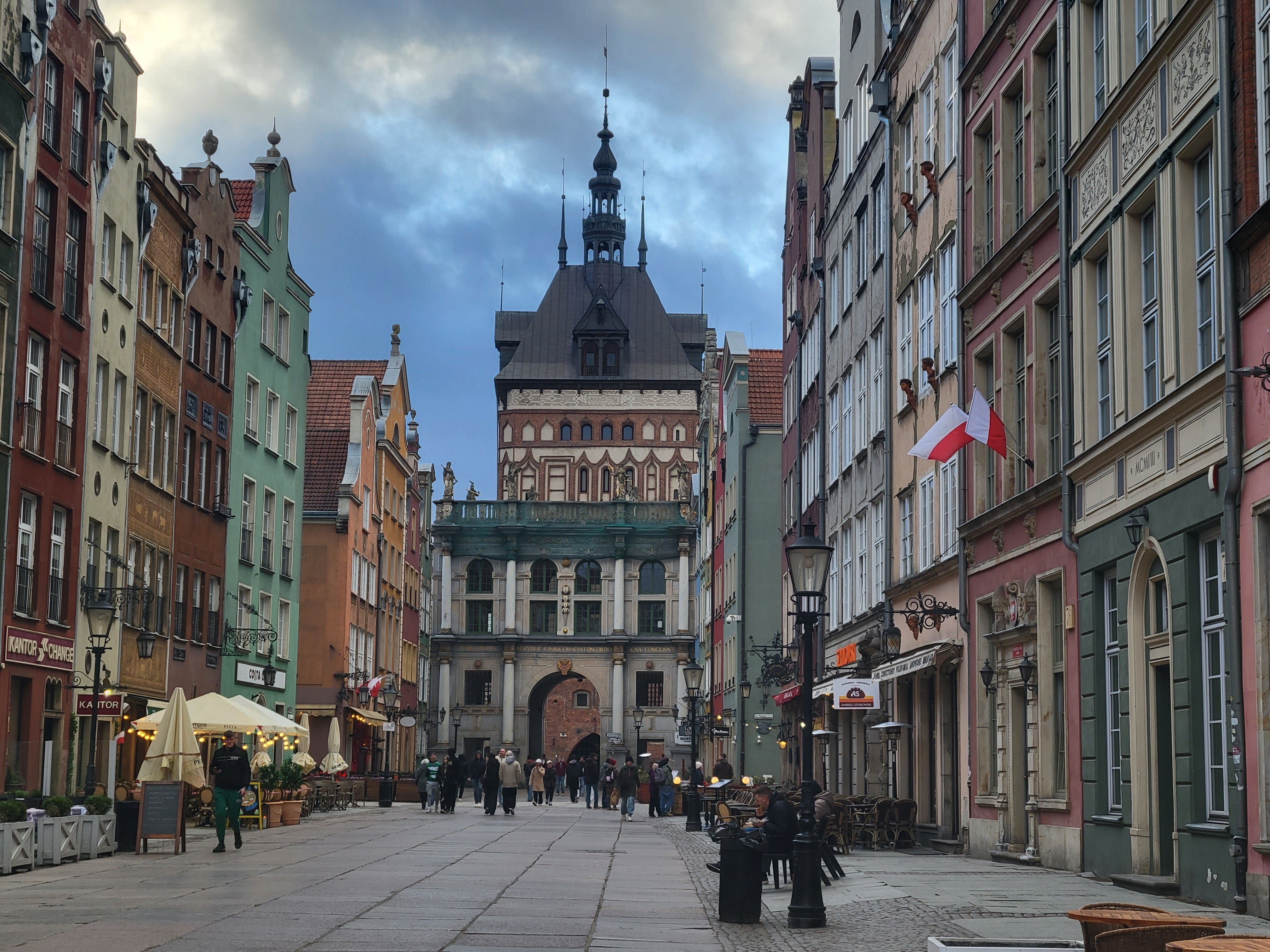
Our Getaway to Gdańsk
We'll return again and again to this gem on the Baltic coast

I woke up our first morning in Gdańsk the same way I fell asleep, lulled by the church bell at the nearby Basilica of St. Mary chiming the hour. Cool air wafted through the kipped windows of our hotel room in the heart of the city’s historic center, the Główne Miasto or Main City.1
Fun fact: The Main City has most of the historic landmarks, but is not the same area as the Old Town (Stare Miasto), nearby. The area in the Główne Miasto was founded as a separate town by the Teutonic Knights in 1343.
But the surrounding city dates to around the year 980. So after the Main City was merged into the rest of Gdańsk, the older area became known as the Old Town. The Główne Miasto is still very old, just not as old.
I moved the curtains to watch the sun rise over the tops of a row of brightly painted townhouses while my coffee brewed. The city was almost completely silent.
Gdańsk has everything I love about travel - historic landmarks, museums, beautiful architecture, lovely scenery, delicious food - without the overwhelming crowds of tourists and high prices that plague so many other cities.
Just five and a half hours by train from Berlin, it has become one of my favorite vacation destinations. We have been multiple times and I have barely scratched the surface of my bucket list.
One drawback: I do recommend visiting later in the spring or summer, because the weather on this visit (in early April) was freezing. The wind coming from the nearby riverfront sometimes felt like it was going to blow me over.
From the Old Prussians to the Teutonic Order and beyond
For a history buff like me, a visit to Gdańsk is like taking a kid who has never tasted sugar to a candy factory.
From the 10th through the 15th centuries, control of it shifted back and forth between the Polish monarchy and the German Teutonic Knights, all the while remaining a powerful member city of the Hanseatic League.
Subsequent centuries also saw the city change hands between Polish and Prussian, then German, rule.
Each of these huge transitions left indelible marks.
Two different times, it became an independent city-state, the Free City of Danzig, once under Napoleon and then again after the Treaty of Versailles that ended World War I.
The first shots of World War II were fired here when a German ship attacked a Polish military outpost on the Westerplatte peninsula.
Second fun fact: Following the destruction of 80 percent of its buildings during World War II - city leaders decided to rebuild the Main City with its landmarks - but not in the way it looked just before the war. They reconstructed it as it appeared during the Renaissance, when it was under Polish rule and at the height of the Jagellionian royal dynasty. 2
The Museum of the Second World War, located along the Motława River near the Gdańsk Shipyard, tells the story of the war and its aftermath from the Polish perspective. It is well worth a visit, even if you think you know a lot about the history of that war.
In the modern era, the city was also the birthplace of the Polish Solidarity movement, which led the overthrow of the postwar Communist government of Poland and the country’s transition to democracy and independence from the Soviet Union.
The European Solidarity Center, located within the Gdańsk Shipyard, tells the story of the movement and its impact on the end of the Cold War.


Shopping and eating
I know for most people vacations are about more than museums and historical markers. And Gdańsk doesn’t disappoint there, either.
In addition to ship-building, its known as the world’s amber capital, producing 70 percent of the world’s amber products.
Boutiques, galleries and workshops along Mariacka Street, as well as Długa, and Długie Pobrzeże are the best places to see the work of local artisans and to shop for amber jewelry and other products.
I have heard that you can even find nuggets of amber washed up along the beaches of Gdańsk and the nearby cities of Gydnia and Sopot, but I haven’t done this myself.
When you get hungry, you can find restaurants specializing cuisines from both Poland and around the world. In addition to the famous pierogis at Pierogarnia, and the awesome Neapolitan-style pizza at Ostro, there were spots for tapas, ramen or Mexican food in walking distance from to our hotel.
We also liked the food hall, Słony Spichlerz, which has 10 different food concepts and two bars. It is conveniently located just across the river on Granary Island and we liked that we could walk over the pedestrian Holy Spirit Bridge (Kładka Grzegorza) to get there.


Sopot and Gdynia
Gdańsk is part of the Polish Tri-City (Trójmiasto) a conurbation with the nearby Baltic beach resort town of Sopot and the port city of Gydnia, all located on the shores of Gdańsk Bay.
In warmer weather, taking the SKM rapid transit commuter rail to either or both is an easy way to spend a day at the beach while you are staying in Gdańsk.
Sopot is known as the Riviera of Poland and is home to several white-sand beaches, plus the longest wooden pier in Europe. Another attraction is the Sopot Lighthouse, built in 1904.
Gdynia is a bigger city, and a major port (several luxury cruise lines dock there) but also has several lovely beaches and a waterfront that features numerous museum ships and other activities.
Getting there and getting around
If you visit, I recommend staying in the Main City. It is easily accessible to the main train station (Gdańsk Główny). It was about a 12-minute walk from there to our hotel near the basilica. You can also take a tram to within about a five- or six-minute walk.
Cars and buses are restricted from traveling inside the historic area, which means you won’t have to worry about being awakened by car traffic or getting run over in the cobblestone streets. But if you have a lot of luggage or need to travel by cab for accessibility reasons, you would need to schedule one through your hotel. We saw some parked in the rear parking lot of our accommodation, so they must be allowed in for single trips.
Public transit in the city is awesome. There is an extensive and easy to use bus and tram network in Gdańsk, and the SKM commuter rail that runs along the coast and provides access to all of the cities and towns in the TriCity region. Gdynia and Sopot also have their own local transit networks. The Metropolitan Ticket is an all-inclusive ticket that lets you ride on any of the transit in the TriCity region, including the commuter trains.
Gdańsk is a pretty bike-friendly city, even outside the pedestrianized Main City. There are numerous cycle routes for sightseeing along the river and around the harbor. I am definitely a fair-weather biker only, so we did not rent bikes this time. But my husband and son did ride a lot on a previous visit.
Read More
If you want more detailed information about Gdańsk and travel tips from some locals, check out these posts from other writers. They are where I found some great ideas and recommendations.
Into the Bloom: 26 Best Things to do in Gdańsk (A Local’s Guide)
Inside Laura’s Head: A Complete Guide to Gdańsk, Poland
Visit Gdansk: A Good Time for Gdańsk
In Your Pocket: The Royal Way
Unlike a lot of Polish and European cities, the Old Town and Main Town districts in Gdańsk refer to different areas. In a lot of places, the ‘old town’ will be the old city center and have most of the landmarks and tourist destinations. In Gdańsk, this part of town is called the Main City and the Old Town refers to a different area in the same district. There are some historic buildings in Gdańsk Old Town, including the beautiful main railway station. But most of the landmarks you will read about are in the Main City.
When it became part of Prussia during the 19th century, German leaders renovated the facades the old buildings to give them a more neo-Gothic ‘German’ character. And they had removed the landmark protections given to buildings like the Artus Court and the main town hall. These have now been restored.


