

The Paper Chase
Making our presence in Germany more permanent

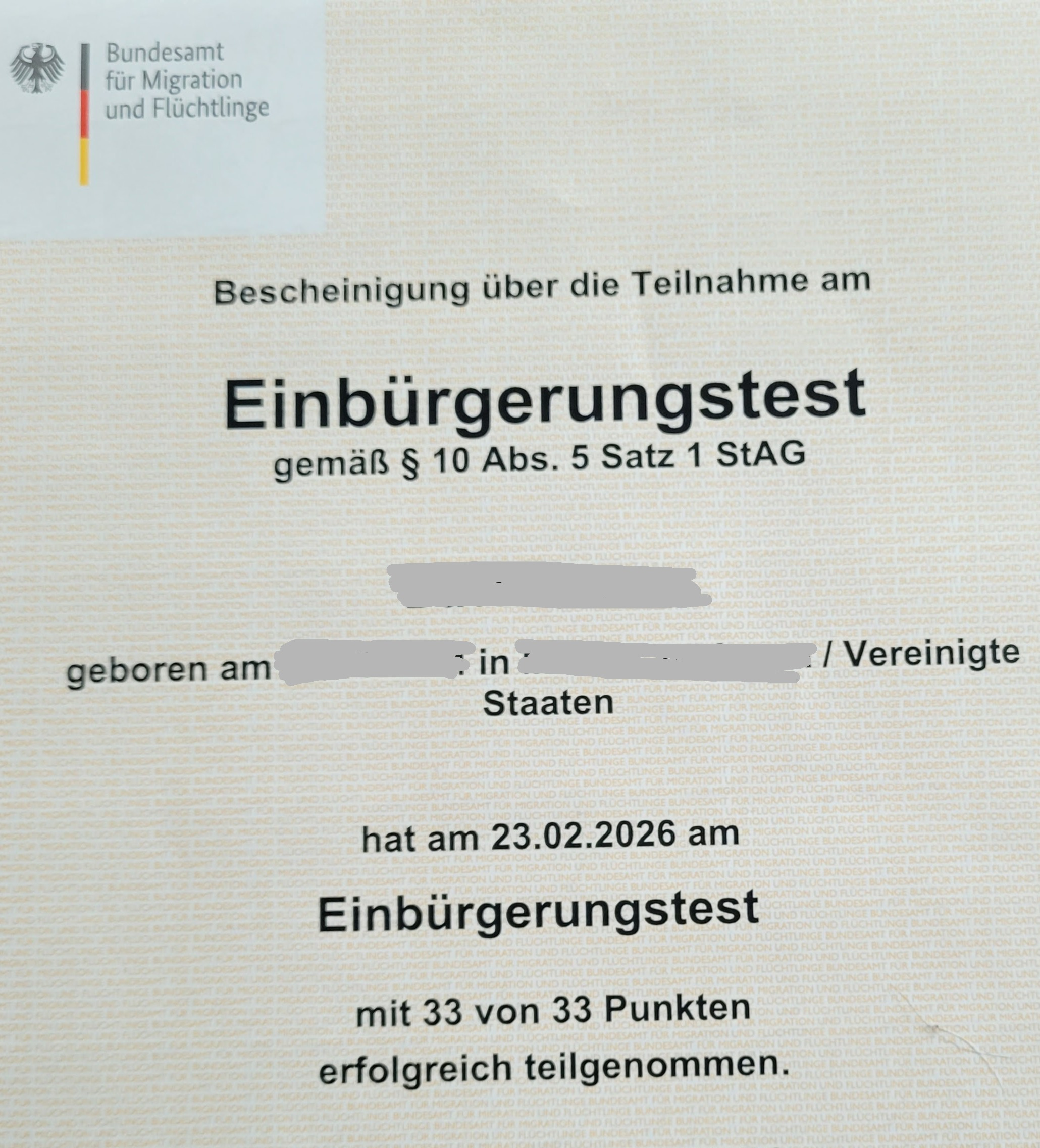
My husband just passed his Leben in Deutschland test, with a perfect score—33 out of 33 questions correct.
This is important because it was the last required task before he could apply for permanent residence (the Niederlassungserlaubnis). Leben in Deutschland (literally, “Life in Germany”) is the official Einbürgerungstest, the same test you take if you want to become a German citizen. But it’s required for permanent residence, too.1
Because David is here on an EU Blue Card, he can apply for PR after just three years. Non Blue-Card holders (like me) have to wait for five.2
He is our anchor here - in more ways than one. His job with an international tech company allowed us to move here in the first place. His security as a permanent resident will mean that we won’t have to leave if he changes jobs or loses this job and has to look for another one.
This is important as layoffs in the tech sector become more common.
My daughter, who just turned 18, is embarking on a separate journey. When her current residence permit expires in 2027, she will have to apply for one of her own - preferably on a student visa in whichever country she attends university. But where that will be is - at the moment - still being determined.
She is currently working in a minijob and taking classes at a language institute to improve her German fluency. Many universities here require evidence of a C1 level of German before admission to an undergraduate program - even if the language of instruction in that program is English.

My son, 15, is in the middle of a paper chase of a different kind.
When his current permit expires - also in 2027 - he will be 17 and eligible to apply for permanent residence. To get it, he will have to show that he has sufficient German language skills and is either enrolled in or has completed full-time education or training.
A valid diploma from his German secondary school would be considered proof of both language skills and sufficient training. But getting said diploma is no simple matter.
He is currently in Klasse 9 at a Berlin integrated secondary school. At the end of the year, all students will take exams for the BBR (Berufsbildingsreife - basic vocational diploma). The exams are in the subjects of German and in mathematics, but in order to be granted the Schulabschluss (literally, ‘school leaving’ qualification) you also have to have passing grades in all required school subjects.3
His subjects this year are:
German (this is a language and lierature class similar to English as a subject in the U.S.),
Math,
English (this counts academically as his “first foreign language”),
Biology,
History,
Chemistry,
Physics,
Political Science, and
Sport (Physical Education),
Art + Music (half-year of each).
When I was first researching the diploma requirements, I thought he could just focus on German and math. Somehow it never registered how hard it would be to take all required high school level courses in a language he only began learning two years ago. And how many different subjects that would be.
For example, all students in Berlin take physics and chemistry beginning in the Klasse 7 (7th grade), whether you attend a university-prep Gymnasium or a Realschule or an integrated secondary school, like ours, that offers all qualifications. This was not the case in the school district we moved from, and he had never studied them in any language.
He has been granted an exception as an ‘NDH’ student (this stands for “nichtdeutscher Herkunft” - non-German heritage) for skipping some additional elective subjects (he takes remedial German language classes, instead), and not taking a second foreign language, which is required for students who want to pursue the German Abitur.
But the subjects above he has to take and pass - all in German - if he wants to get even the most basic school qualification.
Like most high school students, my son worries about his grades and his future. But he has the added concern (we have not really talked about this with him, yet) that the immigration office can reject his application if his grades aren’t good or he doesn’t have at least a basic diploma. In short, if they think there is a reasonable likelihood he would not be able to get a job and would be a burden on the state.
Reading this, you may be thinking: That’s a lot! Why would you even do this?
It is a lot.
But also, people do it.
It’s not like we’re the only ones.
His school is half full of students who came from other countries and learned German. They speak another language, sometimes multiple languages, at home and speak German at school. And, among our other immigrant friends and David’s colleagues, are several kids who are on the same path. (Nachhilfe - tutoring - is a booming business in Berlin.)
We still think Germany offers better educational and career opportunities for both of our kids than they would have if we remained in the United States. If they choose to remain here as adults, they will have access to affordable health care, be protected by stronger labor laws, and live in cities that are, on the whole, greener and more sustainable.
That being said, we have always had a Plan A, Plan B, and Plan C in mind for all of us in case this whole gamble doesn’t work. (And my anxiety brain is usually busy working on Plans D - Z as well.)
And when things like this come up4 - as they seem to more and more frequently - it does give me pause.
What if they change the citizenship rules before we can apply? What if relations with our home country deteriorate to the point we get kicked out?
Will we have spent all this time and money and effort to build a life here for nothing?
(Part of the reason we want to eventually apply for German citizenship is because - with it- we would have the right to reside in any EU member country. We also want it because we want to be able to vote.)
As non-citizens, Germany owes us nothing. We have given them our tax dollars and our labor. In return, we get to live here and another roll of the dice on getting to stay.
We came here through a program that the German government established to recruit immigrants to move here. But governments and laws can change.
That is the gamble that every immigrant you know has made, is making, every day. We did not come to another country to take over or take advantage. We wanted to add to, as well as benefit from, its community.
Whether we will be able to, remains to be seen.
As the spouse of a Blue Card holder, I could also apply for permanent residence after three years - but only if I am employed in a job paying the equivalent of a Blue Card salary - essentially independently eligible for a Blue Card on my own - and I am not. I can apply after he gets PR - I think - if I am working at least 2ß hours a week and have a language level of at least a B1 on the CEFR.
If students don’t qualify for the BBR after 9th grade, they can take it again in the 10th. Students who do get it after 9th, will take the tests for the eBBR/MSA at the end of 10th. Teachers at the beginning of the year prepared all the parents for exactly this situation.
The linked article is in German and covers the vote by the youth wing of the Christian Democratic Union party to change the waiting period for naturalization back to eight years from the current five. I have only seen that reported in the German-language media, not in English.
Do you speak German at home
Thank you for your series on German life for an immigrant. I have a few EU born and raised friends and they are astounded by the amount of misinformation we (in the US) get about EU life.
I have a Swiss friend (Basel), now in his early 80’s. We worked together in a Swiss pharmaceutical company here in the States and he was always amazed that a HS grad in the EU was often technically competent to compete with a US college grad for an entry level laboratory job. Is it your sense that is still valid?
Thanks again,
Barry