
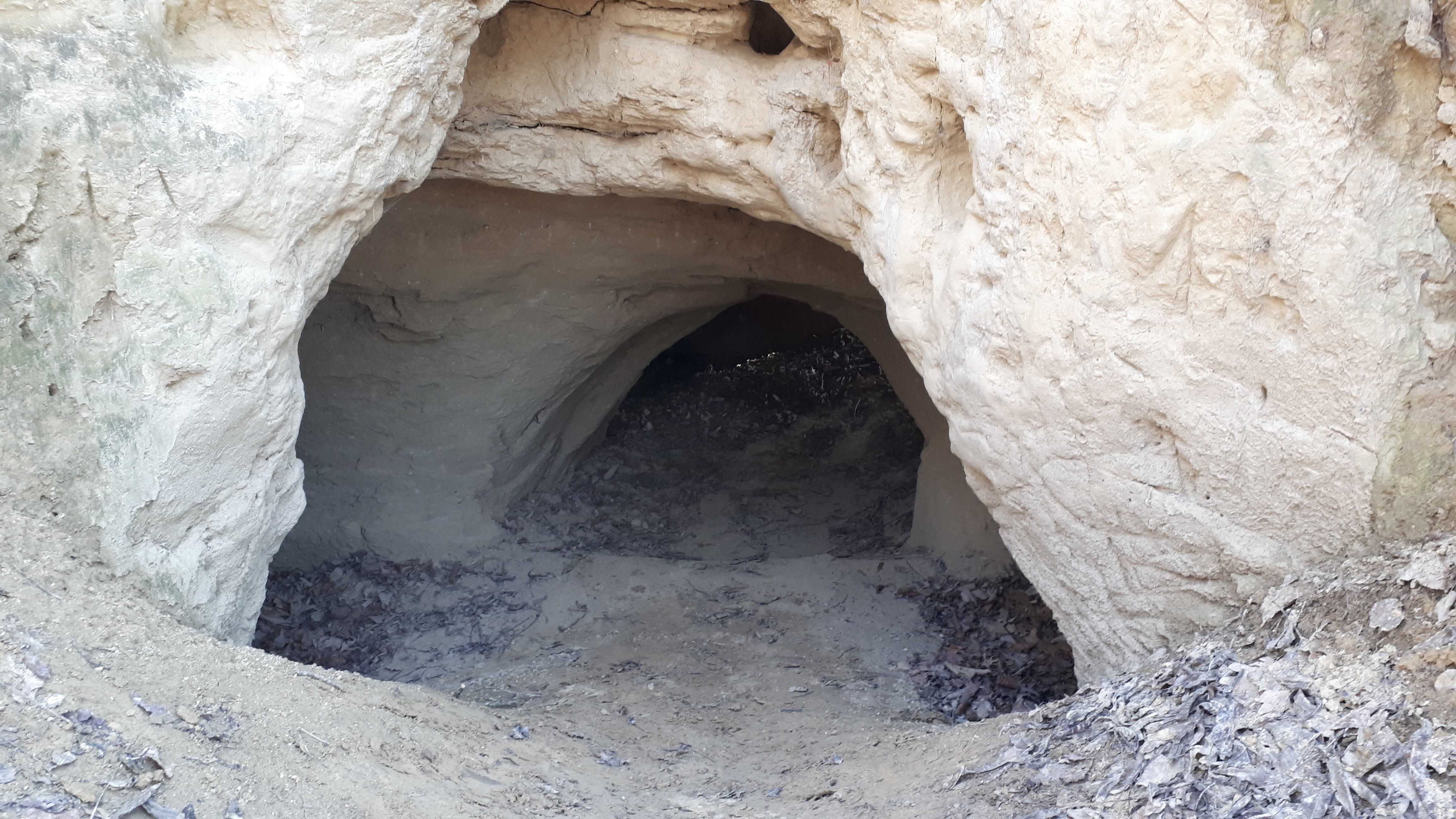
Who Built the Erdstalls and Why?
Medieval bug-out bunkers or places for secret cult ceremonies - no one can say for sure.

It is a mystery that has puzzled European historians for hundreds of years and is still hotly debated. Who constructed the thousands of narrow, empty, underground tunnel networks scattered all over Europe?
Known as ‘Erdstalls’ — the etymology is from the Middle High German erde for ‘earth’ and either stelle for ‘place’ or stollen (mineshaft) — they are most heavily concentrated in southern Germany and Austria. (There are more than 700 in Bavaria alone.) But they have also been documented in Hungary, Spain, France, Ireland and Scotland.
I first heard about them from this article in the newsletter, weird medieval guys.
Just reading it gave me the heebie jeebies.
They only ever have one entrance, usually located beneath the floor of a church or farmhouse, or simply under the flagstones of a town square. After an initial drop, the tunnels run for a few dozen metres, sometimes branching or dropping down to lower levels via narrow shafts. Often, the tight tunnels widen in the middle or toward the end into small chambers with rudimentary benches or shelves carved into the earth.
And more erdstalls are still being discovered.
In January, officials with the Office for Heritage Management and Archaeology in the German state of Saxony-Anhalt announced the discovery of a set of tunnels located within a prehistoric burial ground near the town of Reinstedt in the Harz Mountains.
According to a press release, archaeologists were surveying the area late last year ahead of plans for the construction of wind turbines. Excavations revealed a trapezoidal burial ditch common to the Baalberge culture - a Neolithic group that inhabited the region around the third and fourth millenium BC.
The ditch dates to around 3,000 BC, and several human burials in the “crouched” style common to that group were documented. But then:
In the southern part of the trapezoidal trench, a long oval pit, approximately two meters long and up to 75 centimeters wide, was discovered, which cut across the trench at almost a right angle.
To the north of the pit lay a large stone slab.
This led to the assumption that it could be a grave – however, during the course of the excavations, the findings turned out to be something completely different.
The pit fill showed layers sloping diagonally to the north and did not end, but led deeper and deeper into the light-colored and very solid loess subsoil into the interior of the Stone Age structure.
Late medieval pottery and numerous stones were found in the fill, and smaller cavities had also been preserved in the upper part. It quickly became clear that this was a so-called earth stall.
[Translated from German with help from DeepL.]

The researchers could tell that the intersecting tunnel was newer because of the medieval-style pottery, as well as a horseshoe, and some small animal bones that were found in some of the cavities.
“Around a dozen such findings are known from the federal state of Saxony-Anhalt, which means that the density of these structures is lower in our region than it is in others. Their function has not yet been clarified and may also vary from case to case,” archaeologist Jochen Fahr told the publication 404 Media.
“Possible interpretations include hiding places in case of danger or storage cellars,” Fahr continued. “A cultic-religious function could also be possible, as a kind of Christian chapel. The interpretation of these structures is made more difficult by the fact that the examples known to us contain little or no archaeological finds, which makes it very difficult to draw any firm conclusions on their function.”
What makes them different
You may be thinking - as I did - that southern Germany and Austria, in particular, have lots of old underground tunnels known to have served a variety of purposes.
The Felsengänge in Nuremberg are a complex labyrinth of tunnels underneath the oldest part of the city that were originally constructed to ferment and store beer. A completely separate set of subterranean passageways can also be found underneath Nuremberg Castle, built to help defend it during attacks and allow castle inhabitants to escape undetected.
Then, there are a series of catacombs beneath the Stephansdom in Vienna, whose purpose is obvious.
And these are just the places I have seen personally.
According to my tour guide Nuremberg, the beer storage tunnels were initially just extensive subterranean basements dug out beneath individual homes that were then connected to each other over time. The multiple exits, ventilation shafts and wells were constructed later.
Could this have been the beginnings of some similar storage areas that were just never completed?
No one wrote about the Erdstall
That seems unlikely, most historians say.
First, the erdstalls are much, much smaller - only a maximum of four feet high and two to three feet wide. In the larger entrances, an adult - even a small one - needs to bend over at the waist just to enter. (And, no, medieval Europeans were not substantially shorter than people today.)
Some passages require getting down on all fours to crawl through, others are traversed only by “crawling like a worm,” to quote one of the few people to explore them.
There is only ever a single entrance/exit. Although there may be many connecting passages underground with levels above and below the entrance, they all lead to dead ends. People who have crawled through them have sometimes had to cut their visits short due to lack of oxygen in the deeper recesses.
In some of the German-speaking areas, the erdstalls are known as Schratzlloch (goblin holes) or Zwergloch (dwarf holes) and legend says they were created by these mythical beings.
Radiocarbon dating puts the time of the construction of most of the tunnels during the Middle Ages, between the 10th and 12th centuries. But there have been very few artifacts found inside any of them, unlike other tunnels and structures of similar (and older) ages.
And, it seems that they were supposed to be a secret.
A passing reference in the year 1449 from tax records in Asparn, Austria mentions the location of a piece of property as being “auf den Erdstellen” (“on or above the erdstalls”). This is the only reference in any written records.
Despite there being thousands of such labyrinths of roughly the same age, dug all across the continent, with extremely similar designs and sizes, no one wrote about them.
What were they for?
Experts are divided on what purpose the erdstalls originally served.
The lack of artifacts like remnants of food or clothing plus the very tight passageways leads many to conclude that they weren’t used as refuges in times of conflict.
Some have posited that the tunnels were used for pagan rituals or some other spiritual purpose. One theory holds that they were built by a group of Irish - Scottish Christian monks who traveled around Europe in the 6th century as missionaries.
Austrian historian Heinrich Kusch thinks many of the tunnel networks are actually much older and were likely built around 5,000 years ago by the Neolithic inhabitants of the region. This would explain the lack of writings about them because chroniclers in the Middle Ages wouldn’t have known what they were for either - just that they were there.
Others say that the purpose is clearly defensive and people used them to hide from hostile invaders, as did their descendants hundreds of years later during the Thirty Years’ War.
Austrian researcher Josef Weichenberger believes the ones there were built in the 11th century during a time when groups of settlers were migrating from what is now Bavaria in search of new land to farm in the east.
Robbers also posed a threat in the region, he told Der Spiegel. They raided remote villages and used crowbars to get into the houses. Weichenberger believes that the farmers quickly fled underground “from this vermin,” taking their valuables with them.
In Weichenberger’s version of the mystery of the subterranean galleries, the terrified villagers would sit in their hiding places underground, their hearts pounding, while the intruders raged above ground, searching in vain for valuables.

So why do you think the erdstalls were built? Or, were they built at different times for different reasons? Leave a comment and let me know your theory!
And thanks to Olivia at weird medieval guys and Becky Ferreira at 404 Media for giving me my latest historical obsession.
Sources and More Information
weird medieval guys. The secret medieval tunnels we still don’t understand. Jan. 20, 2026.
Becky Ferreira. Scientists keep discovering mysterious ancient tunnels across Europe. 404 Media. Feb. 4, 2026.
PressInformationen. Spätmittelalterliches Versteck im jungsteinzeitlichen Grabengeviert – Erdstall bei Reinstedt, Landkreis Harz, entdeckt. Landesamt für Denkmalpflege und Archäologie. 29. Januar 2026.
Matthias Schulz. Experts baffled by mysterious underground chambers. Spiegel International. July 22, 2011.


